A travel and photography blog by Loke Chee Meng
About the title shot :
In the autumn of 2009, I found Little Bugsie, of all places, on a toilet sink in the Days Landscape Hotel located at the foot of Changbaishan, Jilin, China. I invited Bugsie into the room. I gave it the 'red carpet' welcome and took the shot above with a Panasonic DMC-LX3.

Showing posts with label Travelogue. Show all posts

Tuesday, 25 April 2017

I went to Hakodate


On the morning of 12th December 2016, I arrived at Hakodate (Hokkaido, Japan)  with the delegation from the Singapore Tourism Board comprising STB’s senior management staff and the other winners of the 2016 STB Customer Service Awards.  I am honoured to be a member of this delegation in my capacity as the recipient of the Customer Service Award representing National Gallery Singapore.

We were welcomed at the airport by the committee members of the HSS (Hakodate Singapore Society) and HITCA (Hakodate International Tourism and Convention Association).  It was a great honour as the committee members are business leaders of Hakodate and most of them are multi-millionaires in their own right.
Picture above : Night view of Hakodate Bay

Over the last 35 years, I have made many trips to Japan.  Each time, the courtesy and discipline of the people, the quality of the products and services, the efficiency of the system and the cleanliness of the place have never failed to impress me.  It was no exception this time.

Little known to most of us, Singapore has a close relationship with the city of Hakodate in tourism.  The Hakodate Singapore Society was founded by the late Mr Masaru Yanagisawa in 1992.  He was instrumental in developing the close ties between Hakodate and Singapore.  One of the significant contributions of HSS is that it has been hosting winners of the STB Awards since 1999.  Members of HSS had also participated in our Chingay processions in the past.

The late Mr Yanagisawa was so impressed with Singapore’s success that he had requested and was granted permission to erect a merlion (actually it is one big merlion and two small ones) at the Nanae Hama Beach in Hakodate.  Of course,  a visit to Hakodate is not complete without a visit to our merlions.  However, it was a pitiful sight to see the merlions rather unkempt sitting on a desolated beach.  HSS should perhaps relocate the Merlions to the Hakodate Bay Area, an area somewhat like our Clarke Quay.

Picture above : Our merlion at Nanae Hama Beach

There were official and informal events in our itinerary.  One of the highlights was the official light up of the Hakodate Christmas Fantasy at the Bay Area by the Singapore delegation.  It was awesome when we pressed the button the huge Christmas tree behind us lighted up and fireworks shot up over the Bay.  Then there was a courtesy call to the Mayor’s office.  I had goose bumps as I entered the Hakodate City Hall with the Singapore flag flying high next to the Japanese flag outside.

Picture above* : The Singapore flag flying outside the Hakodate City Hall

As part of cultural exchange, we visited the Hakodate Shirayuri Senior High School.  This was the first time I visited a school in Japan and an elite girl school at that.  It was evident that the girls had spent a lot of efforts in preparing various items to introduce Japanese culture and traditions to us. I wish we had more time in the school.

We had sightseeing too.  It was a pity that we did not get to the top of Mt Hakodate to view the famous night scene of Hakodate as the mountain was closed due to an accident the day prior to our arrival.  Nevertheless, we did visit several places of interest including the Goryokaku Fort and Tower, the Old Hakodate Public Hall, the Nanae Snow Park and Lake Onuma.
Picture above : Goryukaku Fort seen from Goryukaku Tower

Picture above : Mt Komagadake seen from Nanae Snow Park
Picture above : A frozen Lake Onuma

We left Hakodate on the 16th morning.  It had been snowing since the night. However, our Japanese hosts had once again demonstrated their warmth and hospitality.  They were at the airport to send us off and did not leave until we boarded the plane.  This is the kind of exemplary courtesy and hospitality that has impressed me for 35 years.  I have never bowed so much and so deeply.   But our hosts rightfully deserve all that.

There is no better place to appreciate and learn the finer points of service excellence than Japan.  The Japanese has perfected their ‘service excellence and courtesy’ practices into an art form.  The whole customer service industry in Singapore has a lot to learn from them.  When it comes to the finer points, it is all about discipline and mindset. If I may draw an analogy, it has become an art form somewhat akin to the display grace and elegance in the exquisite art of Sado and Ikebana. 

Monday, 23 May 2016

Tassie Tassie here I come!

I went to Tasmania last month.  Beautiful place.  But it may take a while before I get down to write something.  That is called inertia.

17 May 2017 - Now I know this is bad.  It has been one year since I went to Tasmania and I have not written anything about the trip.  Inertia, Inertia, Inertia!

Wednesday, 10 February 2016

Visit to Twin Pagodas Hill - Did I make history?

I may very well be the first Singaporean to visit this place called Twin Pagodas Hill in Chengde, China.  A lot of people living in Beijing do not know of the place.

In October last year when I visited Beijing, I went to the Qing Dynasty's Imperial Summer Resort in Chengde.  Chengde used to be called Rehe (meaning Hot River) during the Qing Dynasty.  As a matter of fact, the later Qing Emperors spent more time in Rehe than in the Palace in the Forbidden City in Beijing.  On the northeastern side of the Imperial Summer Resort about 30 minutes drive away is a nondescript hill.  But on top of this hill is something unique and stunning.   Two huge rocks about the height of two 20-storey buildings stand shoulder to shoulder next to each other.  On top of EACH of these two rocks is a pagoda that was supposedly built many hundred years ago. Now, there is no way one can go up to the pagodas.  Well, at least that is for now.  I hate to think of the day some idiotic enterpreneur will build an elevator to fetch tourists to the top and collect 100 RMB per visitor for the ride. And to make it more visitor friendly, add a link bridge between alpha and beta to 'enhance' its appeal.

Look at the photo below, it is unique isn't?   I reached there in the morning at about 10 am. Unfortunately, the weather was not good that day and that was all I could do with the shot.

I think Twin Pagodas Hill is certainly more qualified to be a classified as a UNESCO World Heritage site than some botanic gardens in the tropics.

Twin Pagodas Hill

Saturday, 14 November 2015

Important information to note if you are flying off from Beijing

I went to Beijing again on the 18th October 2015.  This time I visited the Great Wall (again but different segment), Chengde, Bashang and Panjin.  I will write about all these later.  But meanwhile I am quite keen to share the following with readers as soon as possible because I think the information is important.

If you are flying off from Beijing International Airport, be very sure which terminal you are departing from.  Why?  Well, Beijing International Airport Terminal 3 (T3) is 15 to 20 minutes DRIVE away from T1 and T2.  (T1 and T2 are next to each other.)  If you think T3 is next to T2, you are dead wrong! If you get to the wrong terminal, you could very well be in for a lot of hassle.

Next, if you are taking Cathay Pacific Airlines (CX), be very sure you are taking the right airlines. There is a local airline with a name that sounds exactly the same as Cathay Pacific in Mandarin and in Cantonese (though it is written differently).  I will show you the photo later.  So,  if you simply go to Guo Tai (or Kwok Tai in Cantonese) without verifying you may end up in Timbuktu.

This is the photo I promised to show you all.


DISCLAIMER :  THIS IS NOT, I REPEAT, NOT, AN ADVERTISEMENT FOR THE AIRLINES SHOWN IN THE PHOTO OR FOR THAT MATTER ANY OTHER AIRLINES.


Friday, 2 October 2015

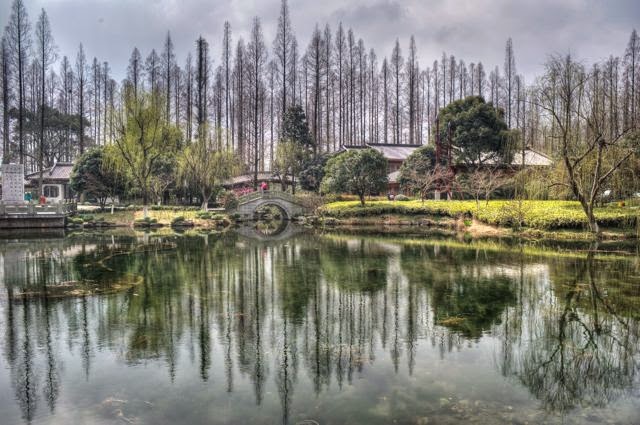
Circumambulating the West Lake


The charm of the West Lake is legendary.

According to a Chinese saying,

Viewing the West Lake on a sunny day is not as ideal as a rainy day;
Viewing the West Lake on a rainy day is not as ideal as a misty day;
Viewing the West Lake on a misty day is not as ideal as a snowy day.

I take that to mean that the more obscure the view, the more enchanting the West Lake is.

There are west lakes and there are west lakes

Before I go on any further, I am of course referring to THE 'West Lake' in Hangzhou, Zhejiang province in China.  Well, the fact is that there are over 30 west lakes in China.  I have been to the West Lake in the city of Fuzhou in Fujian province.  It is nothing like the West Lake in Hangzhou.  So, don't bother to waste time visiting any other west lake.  From now onwards, I will only talk about THE 'West Lake' in Hangzhou.  By the way, there are also many heavenly lakes in China.  The two worth visiting are the Heavenly Lake in Changbaishan and the Heavenly Lake in Xinjiang.  I will write about these two some time later.

The West Lake in Hangzhou is one of the most easily accessible and conveniently located scenic locations in China. It is right in the city and the reasonably priced 4-star Ramada Hai Hua Hotel is just 150 m from the West Lake.  The pricey Hyatt Regency and Shangri-La are also equally well located. I have stayed in the Ramada every time I visited the West Lake.

Circumambulate the West Lake?

In the spring of 2014, I decided to circumambulate the West Lake.  Yes, I mean walk round the West Lake. I felt that in my previous visits I have not really seen the real the West Lake.  So, walking round it should be the best way to see more.  Is that possible?  Yes, it is.  How long does it takes?  I took about 12 hours including breaks for rest and taking of photographs. Was it tiring?  Yes, but not unmanageable.  In fact, I think I managed pretty well considering the fact that I was lugging along my photographic gear weighing about 20 per cent of my body weight.

As you probably already know, there are 10 classic scenes of West Lake:

1) Dawn on the Su Causeway in spring
2) Breeze-ruffled lotus in the Quyuan Garden
3) Autumn moon over the calm lake
4) Melting snow on the 'broken' bridge (The bridge is anything but broken.  The break is a visual delusion due to the melting snow.)
5) Leifeng pagoda in the sunset
6) Twin peaks piercing the clouds
7) Orioles singing in the willows
8) Fish viewing at the Flower Harbour
9) Three ponds reflecting the moon (This name is a bit of a misnomer and a mystery.  There aren't any three ponds.  What one sees are 3 pagoda-like stone lanterns about 2 metres high arising above the water.  This scene is depicted on the back of the RMB1 note.)
10) Evening bell of the Nanping Hill

(These days, the Chinese had come out with 10 'new' scenes of West Lake.  I have not visited any of them.  Firstly, they are spread out over quite a large area in Hangzhou.  Secondly, somehow, I feel that they are mainly tourist's traps.)

By circumambulating the West Lake, I tried to visit each of these locations.  Well I did 8 out of 10!  I did not make it to (9) because one would have to take a boat out to an island in the middle of the lake and (10) because one would have to deviate and go up the hill.

The following are some of the 10 scenes.


Twin peaks piercing the clouds
Leifeng pagoda in the sunset
Fish viewing at the Flower Harbour

Dawn at the Su Causeway in spring

Maojiabu

On the western edge of the West Lake are several smaller lakes called Maojiabu.  This area is seldom visited by tourists and walking along the lakes, one really gets to soak in its tranquility.  Maojiabu is not to be confused with the Xixi, the wetland made famous by the 2008-movie 'If you are the one' staring Shu Qi and Chinese actor Ge You.   Xixi wetland, is a short car-ride from the Westlake.  The following are some shots of Maojiabu.


Tuesday, 22 September 2015

Zhang Yi Mou's impression shows

Zhang Yi Mou, the movie director, has produced several large scale, live, on location shows at some of China's most notable scenic attractions.  His shows involving several hundred performers make creative use of light and sound woven into the location's setting.  The content of the show is invariably about the local customs and dances. But each show will inevitably contain some elements of surprise that vow the audience.  Zhang is credited to have provided employment opportunities to many of the local people and made a lot of money for himself too.

The following is my impression of Zhang's Impressions. 

Impression of Hainan 

It is set in a stadium-like arena.  The theme is contemporary (his only show with a contemporary theme) and is about young people's yearning to enjoy sun and the beach of Hainan.

One of the surprises is how the stage turned into a sea of water with the clever change of lighting.  I figured out that the stage is actually built of mesh over a pool.  It turns from land to water by lowering the mesh and vice versa by raising the mesh. Another surprise comes towards the end where the back of the stage opens up and 'viola', the beach,  coconut tress and the waves washing ashore highlighted by the clever use of lighting.

My rating: *

Impression of West Lake

This is probably the most unusual.  The performance is carried out on the waters of the West Lake at night.  The storyline is set against the legend of Madam White Snake which in itself is an enchanting tale.

You have boats sailing on the lake and dancers dancing on water.  The highlight is the broken bridge sequence where a huge bridge-like structure (resembling anything but a bridge, least of all, the real 'broken bridge') is mechanically raised from the lake.

The dance sequences with the creative use of light is scintillating.

My rating :***

Impression of Guilin

This show uses the unique characteristic of the Karst landscape in Guilin (more specifically, Yangshuo) as the backdrop.  It also featured the characteristically unique folk songs ('mountain songs' literally in Chinese) of Guilin.

To a large extent, the dance items are similar to the West Lake's with dancers performing 'on water'.

My rating : **

Impression of Lijiang

The only of his shows that is performed in daylight.  The reason is obvioius.  The location is at the foot of the Jade Dragon Snow mountain some 20 minutes drive from Lijiang city.  The audience will be literally frozen if the show is staged at night.

The backdrop is the magnificent 4680m Jade Dragon Snow mountain.  The dances and content are centered around the local tea-trading 'horse gangs' with  real horses galloping around.  Other than that, nothing really unusual.

I think the magnificent Jade Dragon Snow mountain was a distraction as there were several times during the show that I found myself admiring the grandeur of the mountain rather than watching the show.

My rating : *


Sorry, I do not have any photographs of the night shows.  Well, I abide by the rules; no photography and video recording allowed.  Of course, that made me the odd-one-out in China.   Actually, I was prepared to 'follow the custom when one enters the village' as the Chinese saying goes.   However, it does not make sense to shoot anything in the vast night space without a firm tripod.  

Thursday, 30 April 2015

Vista of West Lake from Wushan

Somehow, my piece on 'Circumambulating the West Lake' has been in the works for a while.    I thought I might just put up something short and simple on the West Lake in the meanwhile.

Hangzhou's West Lake is surrounded by mountains that stretch from the northwest to the southeast.  The stretch from the north to the east is flatland wherein lies Hangzhou city itself.  Two structures on the mountains are visible from the bank of the Lake.  In the north and closer to the Lake is the Baoshu Pagoda.  On the south eastern side and a little further from the lake is the Chenghuang Pavilion on Wushan (Wu Mountain).  Incidentally, there are many Wu mountains in China.

During my last visit to the West Lake, I decided to go up the Chenghuang Pavilion on Wushan to take a look at the West Lake from a different angle.  I was rewarded with a 360 degrees panorama of not only the entire West Lake but also the entire Hangzhou.  I believe not many visitors have seen the West Lake from this vantage point.

You have to pay an entrance fee to enter Chenghuang Pavilion which houses a tea house and a restaurant.  There were scarcely any visitors at the time of my visit.

The following are vistas from the top of Chenghuang Pavilion.

View of Broken Bridge and Bai Causeway
View of the Small Yingzhou Islet in the middle of West Lake

View of Leifeng Pagoda

Roof of Chenghuang Pavilion in the foreground and tiny Leifeng Pagoda in the background
As you can see from the photos, the sky was heavily overcast and it fact it was still drizzling when I took those shots.  It was the best I could do in such a weather condition.  I hope to return in future to shoot the glorious sunset from this vantage point.  Also, I must come with an ultra-wide angle lens and perhaps try to stitch together a panoramic shot otherwise I will not be doing justice to the view.

In my post The Blue Sky of Beijing, I have a shot of the glorious sunset over Beihai Park taken from a vantage point on the Jingshan Hill behind the Forbidden City.  I look forward to doing a similar one on the West Lake.

Tuesday, 17 March 2015

My Great Wall Adventure


Mutianyu Great Wall


Many people have visited the Great Wall of China these days.  Most would have gone to the touristy sections like the popular Badaling segment near Beijing where the Wall was built or rather rebuilt majestically. 

I first visited the Badaling segment of the Great Wall of China in 1995.  On 22 June 2012, I embarked on an 'epic' journey travesting the Great Wall (GW) from the eastern end to the Western end. I believe this is a path few Singaporeans have trodden.  Of course, I did not actually walk the 10,000 km all the way. 

The segments of the Great Wall I visited are Hushan, Shanhaiguan, Jiaoshan, Jiumenkou, Badaling, Mutianyu, Huanghuacheng, Jiankou, Han segment in Dunhuang, Jiayuguan, Yangguan and Hanging Great Wall.  There are some other interesting and historical segments which I hope to cover at some other time in future.

Starting from the east

It is frequently said that the Great Wall starts at Shanhaiguan in the east.  That is incorrect.  The Great Wall starts at the Chinese border with North Korea in the city of Dandong in Liaoning province.  Dandong is separated from North Korea by the Yalu River which at its narrowest is merely metres apart.  The Chinese calls the spot ‘Yi Bu Kua’ which means ‘over in one step’.  There, next to the Yalu River is a hill called ‘Hushan’ (Tiger Mountain).  The Great Wall there today is a reconstructed segment of about one km up the mountain. The photograph below was taken on the Yalu River in North Korean waters with the GW on Hushan in the background.  

The Yalu River with the Hushan GW in the background
The starting point of the GW in the east
From Dandong, I took a train to Shanhaiguan, the point where most people says the GW starts. One can understand why this misunderstanding.  This is the point where the GW enters the sea at what is called Lao Long Tou (Old Dragon Head).   Anyone at this location can see clearly that there is nothing beyond except the sea. Hence, the misunderstanding that the GW starts from here.

Lao Long Tou at Shanhaiguan
This is what used to be part of the GW at Shanhaiguan
The Great Wall across a river

Not too far from Shanhaiguan is the Jiumengkou (Nine Gates) GW where the wall crosses the Jiujiang River.  Well, what I saw was a very well built or rather re-built river-crossing GW but historically, that was the way too.  From Shanghaiguan, I then took a train to Beijing.

GW at Jiumengkou
'One isn't a hero until one reaches the Great Wall'

At the 8th Tower of the Great Wall at Badaling, there is a stone inscribed with the quote 'One isn't a hero until one reaches the Great Wall' attributed to Mao Tze Tung. (The inscription is of course in Chinese.)  Tourist guides always tell visitors that Mao said that when he climbed the Badaling Great Wall.  There is no official record of that.

The quote ‘One isn’t a hero until one reaches the Great Wall’ came from one of Mao’s poems which he wrote in Oct 1935 on the Long March.   The Red Army had reached the Great Wall at LiuPanshan in Ningxia Province. There, they fought a fierce battle with the enemy and won heroically.  

The Cinderella's Castle of China

There is no doubt that the GW at Badaling is impressively built or rebuilt rather.   It is so touristy and so fake that one feels that this might be Cinderella's Castle.  Climbing the Badaling GW is still an experience though.  But even that experience can be taken away by the cable car service that transport the visitor almost to the top.   The cable car system next to it is a spoiler,  totally incongruent with the grandiose of the monument. (See photo below.)

GW at Badaling
Other than Badaling, there are several other segments of the Great Wall near Beijing.  They are Jinshanling, Simatai, Gubeikou, Mutianyu, Huanghuacheng and Jiankou.  I visited the last three during this trip.

Is RMB10 worth it?

Getting to the Jiankou Great Wall is no walk in the park.  The Jiankou Great Wall is a stretch of unrestored wall standing atop the mountain ridges.   When my driver pointed to me the mountain ridges wherein the Jiankou Great Wall lies, I was not completely sure that he had brought me to the right place.  I could hardly see any walls on the mountain.  Nevertheless from that point onwards, I trekked for more than 2 hours up the mountain, eventually reaching the Jiankou Great Wall.  The trek up the mountain is no walk in the park especially at the upper reaches.  At some point, one literally has to go on all four for the climb.  My climb up was guided by 2 directions; a villager’s advise to keep to the left all the time.  However, I soon found the second and more reassuring way is to follow the rubbish trail.  

The view on top the Jiankou Great Wall was breathtaking. Before my eyes stood an edifice of human ingenuity, madness, sorrow and cruelty all rolled into one.   The Wall itself is completely unrestored and crumbling.  I was the only soul on top the historical marvel other than a local who collected RMB10 from me and had the audacity to ask me if it was worth it.   I did not trek any further on the Wall which was not without its perils as it was already getting late in the day.

Jiankou GW

Solid evidence - my backpack on the Jiankou GW
The Wild Great Wall

The Badaling GW is too fake.  I want to see what the Chinese called 'the wild Great Wall'.   I got my wish granted at the Mutianyu Great Wall.  However, to see that, you have to go beyond the 'No entry' sign as seen in the photo below.

Go beyond this to see the real GW
The real stuff at Mutianyu GW

The real stuff at Mutianyu GW
Huanghuacheng GW
The Mutianyu, Huanghuacheng and Jiankou Great Walls are all around the town called Huairou.  To get to Huairou, one can take bus service 916 at the Dongzhimen bus station in Beijing.  Take the express service and you will reach Huairou in under an hour.  When you reach Huairou, tell the driver to let you alight at the North Street bus stop.  There are drivers there offering to take you to the above for 60 RMB flat one-way (price as at 2012).  The travel time to Mutianyu and Jiankou is about 40 minutes and Huanghuacheng a bit longer.  Considering the distance, 60 RMB is not unreasonable.

From Beijing to Dunhuang

From Beijing, I leapfrogged to the western end of the GW by taking a flight to Dunhuang. There, I saw the vestiges of the Han (Dynasty) GW in the desert waiting for me for 2000 years.  After Dunhuang, I took a train back to the east along the Hexi corridor of the Silk Route stopping over at Jiayuguan before eventually getting back to Beijing.

The Han GW 
Ruins of the first tower of the Han GW 
Jiayuguan 


Xiapu, the most beautiful mudflats in China and maybe in the world


As I walked out of the Xiapu train station one early afternoon in the spring of 2014, my guide Xiao Zhang, immediately identified me from amongst the throng even though we had never met before. Later, he told me he was able to do so because of my dressing.  I took that as a compliment because I was putting on a Northface windbreaker with a Lowepro backpack on my back.

(Learning point #1 – Be alert, Singaporeans do stand out amongst the Chinese.)

Xiapu, the 'city', is the county city of the coastal Xiapu 'county' located at the northeastern end of the Fujian province in China.  Dotting the coast of the county are numerous  fishing villages and mudflats that are reputedly the most beautiful in China if not the world.

It was a cold spring and the weather along the eastern coast of China was foggy and rainy.  Xiao Zhang told me that our itinerary for the next few days would have to be adjusted according to the weather and the tide.

(Learning point #2 – The best period to shoot the mudflats is the few days around the 15th of lunar month.)

(Learning point #3 – It is important to get a guide that understands photography and adjust the itinerary according to weather and tide best suited for shooting.)

That afternoon we started shooting at the XiaQingShan bridge.  This is a long concrete bridge straddling across the bay with scarcely any traffic. But one needs to be alert of the occasional speeding vehicles.  Below the bridge on both sides are fish and oyster farms.  From that location, one can shoot sunrise, sunset as well as moonrise. As it was a foggy day, the shots that I took of fishing boats and poles look better in B&W. I went back two days later for my sunset and moonrise shots.  Yes, moonrise.  This was possible because the bridge runs from north to south.

Shot from Xiaqinqshan bridge

Sunset at Xiaqingshan bridge
Scheduled departure time for D2 was 6 am. The high point of a photo shoot at YangJiaXia must the classic staged shot of the silhouetted farmer and his buffalo under the old Banyan trees with the sun ray piercing thru’ the tree top.

But it was drizzling that morning. So, no farmer, no buffalo and no sun ray for me; only the old Banyan tree.  Nevertheless, we proceeded to Yangjiaxi hoping to catch the mist floating on the river.  Yangjiaxi means the Yang family’s brook, so named as it was the place where the legendary Yang family female warriors of the Sung dynasty once stayed. The walk along the brook that morning was refreshing and serene.

The morning mist of Yangjiaxi
As it would take place everyday over the duration of the trip, the morning shooting session would start at 5 or 6 am, then return to the hotel just in time to catch breakfast.  The afternoon session would start at 2 or 3 pm and return to hotel after the sunset shoot.  It’s siesta from 10 am to 2 pm.

The next day, Xiao Zhang checked the weather forecast and the tide before we set off for the sunrise shoot at Huaju. He would do that every time before we set off.  We were quite happy because we could also see the stars that morning.  On reaching Huaju, we climbed a little slope in the dark and found a good niche to position ourselves for the much anticipated sunrise shoot.  But alas, the sky never seemed to brighten up and soon it opened up.  That morning was a total washout.  I did return to Huaju another day and got the following shot.

Sunrise at Huaju
The afternoon was a saving grace.  The following shot was taken on the rooftop of a school in Shajiang.  This view has been the subject of many prize winning shots by photographers.

The famous S-curve at Shajiang
Everyday we would start with a sunrise shoot and end with a sunset shoot.  By the sixth day, I had difficult remembering the name of the places I had been to. Fortunately, everything was captured on ‘film’ or more appropriately, in bits and bytes.

The afternoon sessions at Xiaohao East and Xiaohao West saw some very good subjects.  At Xiaohao East, I managed to capture some interesting patterns of the mudflat.  The contrast would have been better if there there had been more sunlight.  As a matter of fact, the mudflats produced a lot of interesting patterns.

Mudflat at Xiaohao East
At Xiaohao West, I got onto free rides of the staged shootings of other groups.  I told Xiao Zhang that the next time I come, I would like to have my own staged shootings so that I can get close-up shots.  But the free rides were nevertheless quite interesting subjects.

Fishermen on the mudflat at Xiaohao West
Soon came the sixth day with a morning shoot at Beiqi.  At noon, I left Xiapu on a bus to Fuzhou.  I told Xiao Zhang, I shall return. 

Morning at Beiqi
Most of the shots of the mudflats, sunrise and sunset were taken from high vantage points such as rooftop of buildings and the hillsides.

(Learning point #4 – A telephoto lens of at least 300 mm is a must.)

(Learning point #5 - Try to get a guide who is a photographer who knows what makes a good subject.  There are many guides in Xiapu who are not photographers.  Xiao Zhang's father is a well-known photographer in Xiapu.)

(Learning point #6 – Never go on a photo trip in Xiapu without a reliable local guide.  You will never be able to find and access those vantage points.)

(Learning point #7 – Last but not least, Xiapu is a great place for photographers but not much of a place for holiday makers and non-photographers.)

In August, 2014, I returned to Xiapu for another shoot.

Getting there and away:

I took a train from Hangzhou in Zhejiang to Xiapu.  The county of Xiapu in Fujian province is just next to Zhejiang.  The train journey was about 4 hours long.  I left Xiapu by taking a bus to Fuzhou.  The bus journey took about 2 hours.  I could have taken the train from Xiapu to Fuzhou but did not do so because the Fuzhou train station is quite far away from the city.  


Saturday, 14 March 2015

Two ancient towns and the Tiger Leaping Gorge

Let me start with my most recent trip make in February 2015 to Dali and Lijiang in Yunnan, China.  Dali, Lijiang and Tiger Leaping Gorge are popular tourist attractions in Yunnan which many Singaporeans have been to.  So, I do not want to talk about things you can find in most travel brochures and reviews.  The highlight of my trip was a trek along the Tiger Leaping Gorge which I understand not many Singaporeans have done.

A comparison of the two ancient towns

First, I would like to do a comparison between the two ancient towns, Dali and Lijiang.  Dali is smaller, more rustic, and more like an ancient town.  Lijiang (the ancient town itself) is bigger, well refurbished, much more touristy, looking more like a shoppers' pedestrian mall you can find in many places in China. So, Dali has more character.  Anyone who wants to soak in the atmosphere of an ancient town should spend more time in Dali.


Fig 1: Dali ancient town

Fig 2: Lijiang ancient town


Seeing through a scam

Tourist's traps are aplenty in both towns.  Every other shop is selling silverware/jade and Chinese herbs/tea.  Every local is trying to sell you the wonder Chinese herb, Maca.  In one instance, as I was walking close to a store selling Chinese herbs, almost immediately out of nowhere, a tanned man with dark glasses on appeared next to me and demanded the staff manning the store to show him some superior Maca.  He claimed he is a Chinese physician from the Shandong Chinese Medical Institute and pulled out a pass to prove his credential.  Although he was supposedly talking to the staff manning the store, he made sure that I could see his proof of identity.

I told myself that this is a scam.

1) His approach is too well-timed.
2) His accent is typically local Yunnanese.
3) His complexion is typically local Yunnanese.  As Dali and Lijiang are on higher altitude, the UV light is strong and hence, the locals are quite tanned.

So, I walked away.  Almost immediately, the 'Shandong' Chinese physician also walked away.  When I  walked past the same store half an hour later, I spotted the same 'Shandong' Chinese physician waiting for his prey.

So, please resist from buying any silverware/jade, Chinese herbs, tea or anything expensive.

Another scam

In Lijiang, I had booked a taxi, a proper licensed taxi, to Jade Dragon Mountain.  The driver a middle-age woman, duly arrived to pick me up on time at the hotel.  By the way, many taxi drivers in Lijiang are Naxi women.  The driver told me that Jade Dragon Mountain is too cold in the morning and I should go to Lashihai first.  I was not keen in going to Lashihai, a lake and wetland just outside Lijiang city as I had read that Lashihai is not worth visiting. But it did sound logical that the mountain is cold in the morning so I relented.  On reaching Lashihai, I was brought to a kiosk and introduced to a horse riding/tea drinking/boat rowing package that costs RMB1300 (one thousand three hundred).  Then I fully realised why the driver was so keen in bringing me to Lashihai.  I refused and walked away.  Then my taxi driver and the Lashihai guy entered into a conference.  I was then offered the package for RMB240.  Yes, two hundred and fifty.

So, please don't go to Lashihai.  If you want to go, make sure you pay RMB240 and not RMB1300.

Trekking the Tiger Leaping Gorge

The key attraction at Tiger Leaping Gorge is the Tiger Leaping Stone. Most tourists will take a ride by car to the spot to view it, take photos and then go back.  On 7 Feb, I started my trek at the Upper Tiger Leaping Gorge (TLG) at Qiaotou, went up the mountains, spent a night at a mountain lodge and reached Middle Tiger Leaping Gorge the next day.  As a result, I got to enjoy an exhilarating experience and the breathtaking views.


Fig 3: A view from the top at Upper TLG

Getting there and away

From Kunming to Dali - I took a bus from the Kunming south bus station.  Travelling time was supposed to be about 4 hours.  However, there was a 1 hour traffic jam on the highway due to an accident.  The bus station and the train station in Dali are located at downtown Dali which is some 20 minutes travelling time away from Dali Ancient town.  There is no reason why anyone should stay in downtown Dali since the attraction is Dali Ancient town.

From Dali to Lijiang - I took a bus from Dali Ancient town station which is just 5 minutes outside the the Ancient town.  The travelling time to Lijiang is about 2 hours.  One can also take a train from Dali downtown to Lijiang.  However, that is not advisable because you have to travel 20 minutes to downtown and the train departure is not as frequent as bus.

From Lijiang to Kunming - Originally, I had wanted to take an overnight train with a travelling time of about 10 hours.  However, I found out that the cheapest flight departing at 1 am with a travelling time of under 1 hours costs only RMB350, barely RMB100 more than a soft sleeper on the train.  The only problem was that I arrived at the hotel in Kunming at 2.30 am.  Fortunately, the hotel gave me a room at 6 am without charging me extra.  The hotel is Lake View Hotel.